REVIEW · HO CHI MINH CITY
City Sightseeing Saigon Bus Tour
Book on Viator →Operated by City Sightseeing Ltd - USA and Middle East · Bookable on Viator
Your Saigon sightseeing, on your terms. I like the open-top deck for city views and I like the audio guide in several languages that keeps you oriented as you roll past major landmarks. It’s a hop-on hop-off setup, so you can pace your day instead of playing catch-up.
I also really like the practical add-ons: free Wi‑Fi on board and a free guidebook with maps, recommendations, timetables, and coupons. Those little extras help you plan your next stop—especially when you’re hopping between big museums and busy market streets.
One thing to think about before you choose seats: the main tradeoff is that the audio commentary can feel a bit dry, and the upstairs deck is exposed if the weather shifts. If you’re sensitive to sun or sudden rain, plan to move inside when you need to.
In This Review
- Key things to know before you ride
- How the hop-on hop-off bus tour works in real life
- Red Route vs Blue Route: timing, frequency, and smart line-switching
- Saigon Opera House to Nha Rong Wharf: the Red Route’s orientation hits
- War Remnants Museum and the “must do” factor on the bus
- Ben Thanh Market and the independent palace stretch: classic central Saigon
- Nguyen Hue to the cathedral area: why the ending stop is a smart photo window
- Blue Route: pagodas, markets, and the side of Saigon most first-timers miss
- Open deck vs enclosed seats: comfort tips that actually matter
- Audio guide, guidebook, and Wi‑Fi: how to make the bus more useful
- Price and value: what $21 buys you in a city of long distances
- Where this tour shines (and where it doesn’t)
- Should you book City Sightseeing Saigon?
- FAQ
- Is this a hop-on hop-off bus tour?
- Are there one-day and two-day tickets?
- How long does the Red Route take, and how often do buses run?
- How long does the Blue Route take, and how often do buses run?
- When do the buses start and finish on the Red Route?
- Where is the Blue Route starting point?
- Where is the ticket exchange counter for the Red Route?
- Do I need to pay extra for entrance tickets?
- Does the tour include Wi‑Fi and a guidebook?
- Can I use a mobile voucher?
Key things to know before you ride
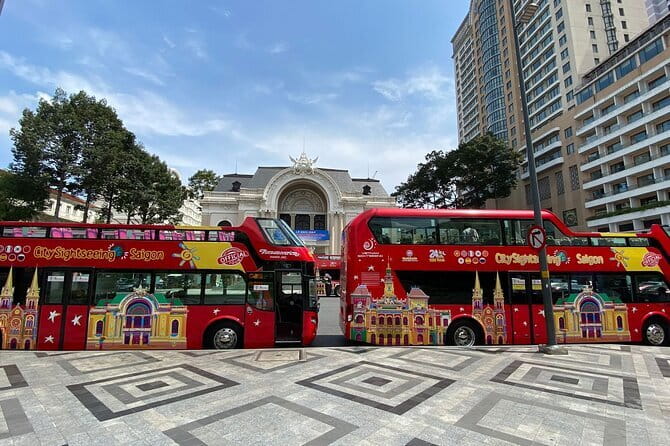
- Two routes, two starting points let you build a loop that fits your day: Red starts at Saigon Opera House; Blue starts by Liberty Hotel on Pham Ngu Lao Street.
- Short riding times, frequent buses (about 75–80 minutes per full route, with frequent departures) means you’re not stuck waiting long between stops.
- You can switch lines at set transfer points around the War Remnants Museum area to connect to the other route.
- Upstairs is for views, inside is for comfort—the open deck is great, but Saigon weather can change fast.
- Use the interactive map idea: it’s an easy way to find the right stop quickly and avoid start-of-day confusion.
How the hop-on hop-off bus tour works in real life
This is one of those city tours that’s built for flexibility. You board at designated stops, ride the route, and then hop off when a place is calling your name—like a museum you want to take slow, or a market street you want to wander. When you’re ready, you catch the next bus.
The timing is set up so you’re usually not stranded. The Red route takes about 75 minutes end-to-end and runs roughly every 30 minutes, while the Blue route runs about 80 minutes with departures about every 45 minutes. Practically, that means you can hop off for a stop, grab a quick break, and still have time to keep moving.
You’ll also get an audio guide while you ride, in several languages, which is useful in a city where streets can blur together fast. The bus itself moves you along some of the biggest names in central Saigon without you needing to plan a complicated route before you even start.
You can also read our reviews of more city tours in Ho Chi Minh City



Red Route vs Blue Route: timing, frequency, and smart line-switching

The tour works best when you treat it like two linked loops. The Red Route centers on a starting point at the Saigon Opera House, with the first departure at 9:00am and the last at 4:00pm from Stop 1. The Blue Route starts at 187 Pham Ngu Lao Street with the bus stop in front of Liberty Hotel, and it also begins at 9:00am but runs later until 3:45pm from its Stop 1.
Here’s the trick that saves time: you can switch lines at specific stops. The guidance notes switching at Stops 6, 7, and 8 on the Red Route, which correspond to Stops 1, 2, and 3 on the Blue Route. In plain terms, if your day is pulling you toward Ben Thanh, the War Remnants Museum area, and then toward pagodas and markets further along, switching lines can keep your walking smaller.
Seat choice matters too. If you want photos, you’ll spend time upstairs on the open deck. If you want comfort and fewer weather surprises, go inside when conditions change. Either way, you’re still doing the same sightseeing loop—just with different comfort levels.
Saigon Opera House to Nha Rong Wharf: the Red Route’s orientation hits
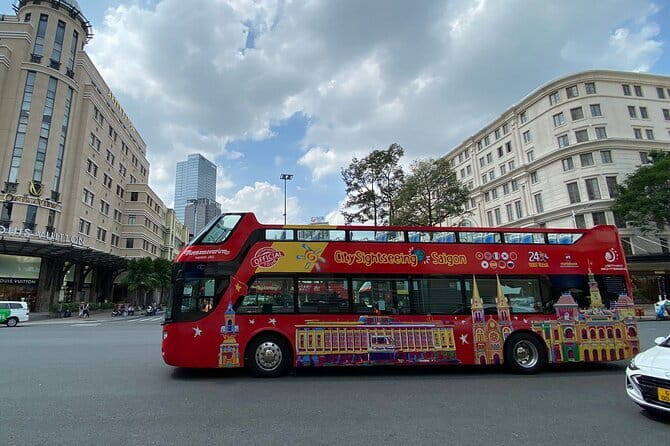
Your Red Route day starts at Saigon Opera House, a handy landmark because it’s easy to spot and it works as a clean starting point. There’s also a specific ticket exchange location: the exchange counter is on the side of the Opera House, facing the Continental Hotel. That detail matters because start-up confusion is the most common annoyance with big bus tours.
From there, the route follows along Nguyen Hue Street, then heads toward the waterfront area at Nha Rong Wharf. This stretch is good for getting your bearings in Ho Chi Minh City: you move through the central grid, then you start to see the “edge” where the city feels closer to water and shipping activity.
A couple more Red Route stops help connect the dots between landmarks: you’ll pass a stop near the Tran Hung Dao Statue area (shown near Tôn Đức Thắng), plus the Ho Chi Minh Campaign Museum / Museum of Vietnamese History stop. Even if you’re not trying to do every museum, the bus ride gives you a low-effort way to confirm what you want to return to later.
One practical tip: if you’re using a paper voucher or a mobile one, keep it ready at the start. The tour accepts mobile and printed vouchers, so you don’t need to hunt for last-minute confirmations—just make sure you exchange/board at the correct stop for the route you chose.
War Remnants Museum and the “must do” factor on the bus

The War Remnants Museum stop is the one that deserves the most attention on the Red Route. It’s positioned after the earlier central sights and before you head toward market streets. If your goal is to see a major Vietnam history experience without building a whole day around it, this is the cleanest stop to target.
The bus format helps you in two ways. First, it drops you close enough that you can decide on the spot if you want to go in now or later. Second, because buses run frequently, you don’t lose your whole afternoon to one long visit. You can do the museum, then return to the route and continue toward Ben Thanh and other central landmarks.
This is also where the route-switch logic starts to pay off. If you want to connect from the Red side to the Blue route later, you’ll be operating in the same general zone. That can reduce backtracking, which is the real enemy of short stays in big cities.
Ben Thanh Market and the independent palace stretch: classic central Saigon

As you move on, the Red Route brings you into the heart of the shopping and street-life area around Pham Ngu Lao Street (often associated with beer street energy) and then toward Ben Thanh Market.
Ben Thanh Market is one of those stops where getting on and off makes sense. The bus gives you an easy drop point so you can walk in with a plan, or just browse and see what calls you. If you’re only doing one market stop, this is a strong candidate because it’s central and it pairs well with the surrounding landmarks.
The tour then continues to Independent Palace. Whether you want to spend time inside or simply use the stop to get oriented, this is a major visual marker on the route. It helps you draw a line between what you’ve already seen on the bus and what you’ll want to explore deeper after you’re back on your feet.
Finally, the Red Route ends up at the combined stop for Saigon Notre Dame Cathedral / Central Post Office. This is a practical pairing: you can check out both in the same general time window instead of wasting your legs crossing across town.



Nguyen Hue to the cathedral area: why the ending stop is a smart photo window

That Notre Dame / Central Post Office stop is more than a tagalong detail. It’s one of the easiest places to finish your route because it clusters big, obvious landmarks in one area. If you like taking photos with buildings that look like postcards, this stop is built for that.
It’s also a good “second wind” stop. If your morning was museum-heavy, you can use the final stretch to do light walking, grab a drink, and just enjoy the city scale around you. If your day is running short, you can hop off there and still feel like you got a full sightseeing loop.
One caution: buses on different routes may look similar at a glance. A smart move is to confirm the route info on the bus itself and match your stop to the right route color/signage rather than relying on how the vehicle appears from far away.
Blue Route: pagodas, markets, and the side of Saigon most first-timers miss

The Blue Route starts at 187 Pham Ngu Lao Street in front of Liberty Hotel, then runs through a different set of scenes that keep your day from turning into only museums and major monuments.
You’ll still hit some major central stops, including Ben Thanh Market and War Remnants Museum again on the Blue loop, so it’s not like you lose the highlights. But then it branches into a broader neighborhood feel with market and temple stops, including Ho Thi Ky Flower Market and Binh Tay Market.
The Blue Route also includes several pagoda stops: Ong Bon Pagoda, Thien Hau Pagoda, and Van Phat Pagoda. If you want variety in your photos and your walking time, this part of the day helps. You’re trading the “big landmark” feel for more everyday visual texture—flowers, market stalls, temple spaces, and the kinds of streets where you slow down just to look around.
There’s also a stop listed as Phuoc An society’s premises. The tour name doesn’t explain what you’ll find there, so treat it as a curious add-on: if it matches what you’re looking for, hop off; if not, stay on and enjoy the ride to the next stop.
Open deck vs enclosed seats: comfort tips that actually matter

The tour gives you an upstairs option on an open deck, which is the main reason people choose these big sightseeing buses. You’ll get better views and more angles for photos.
But the tradeoff is real: the upstairs deck is exposed to changing weather. Saigon weather can shift quickly, and sun plus wind can make you regret standing still too long. If you feel that coming, switch to the air-conditioned interior and keep moving. The goal isn’t to suffer for a picture—it’s to enjoy the ride and spend your energy where you’ll actually stop and explore.
Audio commentary can also be affected by where you sit. If you’re inside, you may hear it more clearly, and you’ll be less bothered by rain or heat. If the commentary pacing feels dry to you, consider using it as a background layer while you focus on spotting landmarks and deciding what’s worth a second look later.
Audio guide, guidebook, and Wi‑Fi: how to make the bus more useful
Audio guides sound like one more thing until you actually use them to connect the dots. With multiple languages available, you’re not stuck guessing what you’re seeing as the bus moves through central streets.
But the content quality matters. If you find the commentary boring, don’t force it. Instead, treat it like a light cue to help you recognize the next major stop, then rely on your own time and curiosity once you’re off the bus. The included guidebook is built for this approach: it comes with maps, recommendations, timetables, and coupons that can guide how you spend the hours after you hop off.
Free Wi‑Fi is a practical bonus. When you’re deciding whether to walk one block more or switch to a different route, being able to check info on your phone helps you stay calm and efficient.
Also, do yourself a favor before you ride: use the interactive map idea. The tip is to download an interactive map from the transport company website to find your bus stop quickly. That single step can cut the chaos at the start of the day.
Price and value: what $21 buys you in a city of long distances
At $21 per person, this tour isn’t a bargain in the “cheap and cheerful” sense. It’s better thought of as buying time and convenience.
What you get for the money:
- A hop-on hop-off format, so you’re not trapped in a rigid schedule
- Stops near major sights, including War Remnants Museum, Ben Thanh Market, and the Notre Dame / Central Post Office area
- Access to 2 routes, so you can mix and match your route plan
- Free add-ons like Wi‑Fi and a guidebook
If you’re short on time, the value comes from reducing planning stress. You don’t have to map every transfer across town. You pick a starting zone, ride, and then decide where your day should go.
If you’re staying long enough to go deep into one neighborhood or museum circuit, you can still use the bus, but you might not need the full hop-on freedom every day. That’s where choosing a 1-day or 2-day ticket helps. A 2-day option can be worth it if you like doing “museums one day, markets and temples another” without redoing transport planning.
Where this tour shines (and where it doesn’t)
This is a strong fit if you want a fast way to see major central landmarks in short time, with the freedom to step off and come back later. It’s also good if you’re the type who hates guessing which bus stop is which—because the route network gives you repeat access to key spots.
It’s less ideal if you’re a die-hard for highly engaging audio narration. The commentary can feel dry, and the audio experience won’t replace a good guidebook or in-person explanations. It can also feel frustrating if you lose time at the start. The fix is simple: double-check your route starting point and head to the right ticket exchange area.
If you’re traveling solo, that flexibility is a plus. If you’re traveling with people who move at different speeds, hop-on hop-off usually keeps everyone happier because you’re not stuck together in a rigid walking line.
Should you book City Sightseeing Saigon?
I’d book this if you want a practical “big sights overview” that keeps you moving without over-planning. The combination of two routes, frequent departures, and major stops like War Remnants Museum, Ben Thanh Market, and the Notre Dame / Central Post Office area makes it a solid value for first-timers and time-crunched stays.
Skip it only if you know you’ll spend most of your time in one small area and hate bus tours in general. If your style is wandering neighborhoods on foot all day, this may feel a bit like paying to be moved around instead of walking.
If you do book: plan your route, choose seats based on comfort, and use that included guidebook plus a stop-finding map. You’ll get a smoother day and more satisfaction from the time you save.
FAQ
Is this a hop-on hop-off bus tour?
Yes. You can join the tour and leave it at your convenience from the designated stops.
Are there one-day and two-day tickets?
Yes. You can choose between a 1-day or 2-day ticket.
How long does the Red Route take, and how often do buses run?
The Red Route takes about 75 minutes, and buses run approximately every 30 minutes.
How long does the Blue Route take, and how often do buses run?
The Blue Route takes about 80 minutes, and buses run approximately every 45 minutes.
When do the buses start and finish on the Red Route?
On the Red Route, the first departure from Stop 1 is at 9:00am and the last departure from Stop 1 is at 4:00pm.
Where is the Blue Route starting point?
The Blue Route starting point is 187 Pham Ngu Lao Street, and the bus stop is located in front of Liberty Hotel.
Where is the ticket exchange counter for the Red Route?
The ticket exchange counter is on the side of Saigon Opera House, facing the Continental Hotel.
Do I need to pay extra for entrance tickets?
Yes. Entry to attractions is not included.
Does the tour include Wi‑Fi and a guidebook?
Yes. You get free Wi‑Fi and a free guidebook with maps, recommendations, timetables, and coupons.
Can I use a mobile voucher?
Yes. Mobile and printed paper vouchers are both accepted, and vouchers can be used any day within 12 months of the travel date selected at checkout.