REVIEW · HO CHI MINH CITY
Private Ho Chi Minh City Tour
Book on Viator →Operated by Vietravel Asia · Bookable on Viator
A day of contrasts, from tanks to incense. This private Ho Chi Minh City tour is built around major landmarks plus flexible timing, so your guide can slow down where you care most and speed up where you don’t. Two things I like right away: the private format for real conversation (not headset lectures), and the way the route strings together history and street life without wasting time.
You also get a proper sit-down Vietnamese restaurant lunch with bottled water, and entrance fees for the key sights are included. The one potential drawback to consider is schedule reliability: one past booking reported the tour didn’t start as planned even after pick-up was confirmed, with little communication. I’d handle that by confirming your pick-up details the day before, and keeping your phone ready for the driver.
In This Review
- Key points at a glance
- The route makes sense: a full District 1 day in ~8 hours
- Independence Palace: a time capsule you can walk through
- War Remnants Museum: powerful civilian stories, not just dates
- Emperor Jade Pagoda: smoke, carved detail, and Taoist-Buddhist imagery
- Notre Dame Cathedral and the French government quarter: brick, towers, and city beats
- Central Post Office: design you’ll remember more than you expect
- People’s Committee Building and Nguyen Hue: when the lights matter
- Dong Khoi Street and Saigon Opera House: colonial glamour in motion
- Nguyen Hue Street: a pedestrian spine for photos and night energy
- Ben Thanh Market: your final stretch of bargains and color
- Lunch and bottled water: a real pause in the middle
- Price and value: what $100 buys in a private day
- Guide quality can shape the whole day
- Who this tour suits best
- Should you book it?
- FAQ
- Is this tour private?
- How long is the Ho Chi Minh City private tour?
- Where does the tour start and end?
- Is hotel pick-up included?
- Are entrance fees included?
- What about lunch?
- What does the tour cover?
- Is it wheelchair accessible?
- Is there a cancellation option?
- What ticket format do I get?
Key points at a glance
- Private tour pacing you control: tell your guide what you want more of, and adjust time on the fly.
- Entrance fees included: major stops are covered, so you’re not guessing about ticket lines mid-day.
- War Remnants Museum has real weight: plan mentally for images and stories about civilian suffering.
- A strong District 1 walking loop: French colonial landmarks from Notre Dame to the Central Post Office to the Opera House.
- Lunch and bottled water included: a real break in the middle, not a rushed snack stop.
- Ends at Ben Thanh Market: convenient for final browsing and shopping before you call it a day.
The route makes sense: a full District 1 day in ~8 hours
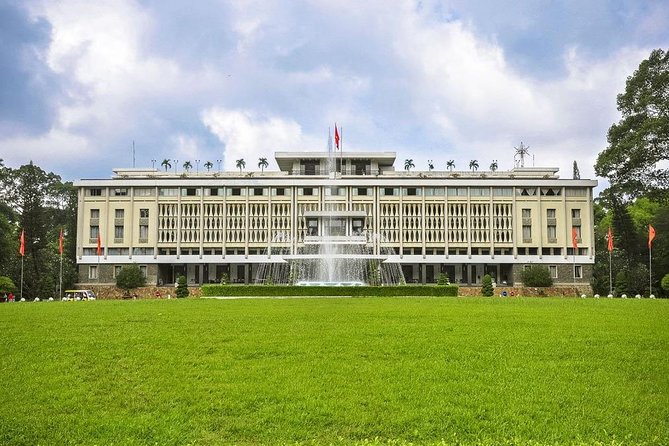
This is an 8-hour private tour that works like a city map in real time. You start at Independence Palace, then move through some of the most important cultural and historical stops in central Ho Chi Minh City before finishing at Ben Thanh Market.
What makes it feel efficient is the order of sights. You’re not backtracking through the city center, and you get a good mix: a political landmark, a hard-hitting museum, a major temple, and then French colonial architecture clustered around District 1’s main streets.
You can also read our reviews of more city tours in Ho Chi Minh City



Independence Palace: a time capsule you can walk through
Your first major stop is Independence Palace, a government building tied to the end of the Vietnam War and the fall of Saigon in 1975. The building’s style is unmistakably 1960s—cooling palms, angular structures, and those quiet, echoing halls that make it feel like time froze mid-action.
The emotional “why” matters here. Even if you know the broad timeline, walking through rooms associated with that final period puts you in the same physical space where key moments played out. The atmosphere is eerie, and the design details are odd enough to keep you looking around instead of just speeding past.
Practical note: give yourself the full time. 1 hour is enough, but don’t assume you’ll be done in 20 minutes, because there’s a lot to take in visually.
War Remnants Museum: powerful civilian stories, not just dates
Next comes War Remnants Museum, one of the most visited places in the city—and for good reason. The museum is known for showing how war affected civilian victims, with exhibits that can be deeply disturbing. It’s not only about battles; it’s about consequences, and it often centers stories that Western visitors don’t usually encounter in other formats.
A key thing to know: some displays are one-sided, but many of the most wrenching photographs are said to include sources from U.S. materials, including images associated with the My Lai Massacre. That mix can be uncomfortable, but it’s also part of what makes the museum land.
How to make this stop work for you:
- If you’re sensitive to graphic content, mentally plan for that before you go in.
- If you’re with someone who wants context, ask your guide to connect the exhibits to what you’re seeing around the city today.
You’ll spend about 1 hour 30 minutes, which is long enough to actually read labels and process what you’re seeing.
Emperor Jade Pagoda: smoke, carved detail, and Taoist-Buddhist imagery
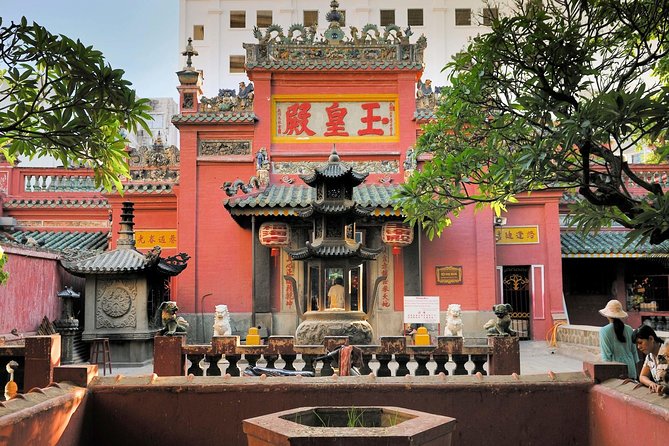
After the museum’s heavy tone, you get a totally different kind of intensity at Emperor Jade Pagoda. Built in 1909 in honor of the Jade Emperor (Ngoc Hoang), the temple is atmospheric in a very sensory way: incense smoke fills the air, and the space becomes a living blur of ritual and detail.
What I find compelling here is the mix of religious imagery. You’ll see statuary connected to Taoist and Buddhist lore, and the descriptions of the temple’s decorative approach match what you’d hope for—carvings, strange characters, and a sense of theatrical devotion. Even the roof’s ornate tile work and the papier-mâché construction of some figures feel like they were made for wonder, not just worship.
This stop is shorter—about 30 minutes—so it’s best for quick immersion without turning into a time sink. If you want photos, do it carefully and respectfully around incense and worshippers.
Notre Dame Cathedral and the French government quarter: brick, towers, and city beats
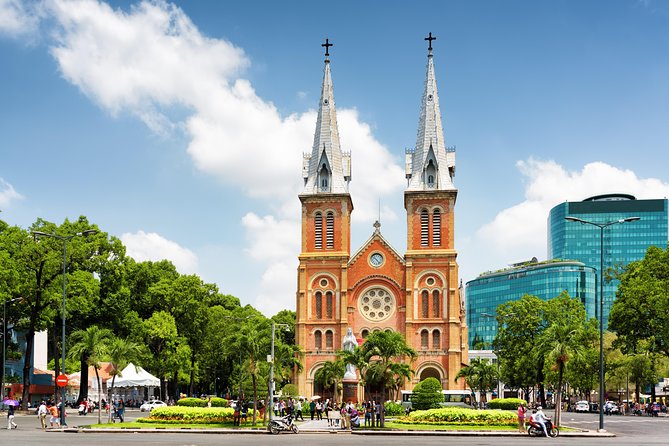
Then it’s back to central landmarks, starting with Saigon Notre Dame Cathedral. Built between 1877 and 1883, it sits in the heart of the government quarter facing Ð Dong Khoi. The cathedral is neo-Romanesque, with striking 40m-high square towers and iron spires.
Inside, you may find devotional tablets and some stained glass still in view. Even if you don’t care about architecture, the cathedral’s location helps: you’re right in the thick of District 1, where the modern city and colonial-era shapes coexist.
This one is about 20 minutes with no paid admission expected on this itinerary, so treat it like a quick signature stop—look, breathe, then move on.
You can also read our reviews of more private tours in Ho Chi Minh City





Central Post Office: design you’ll remember more than you expect

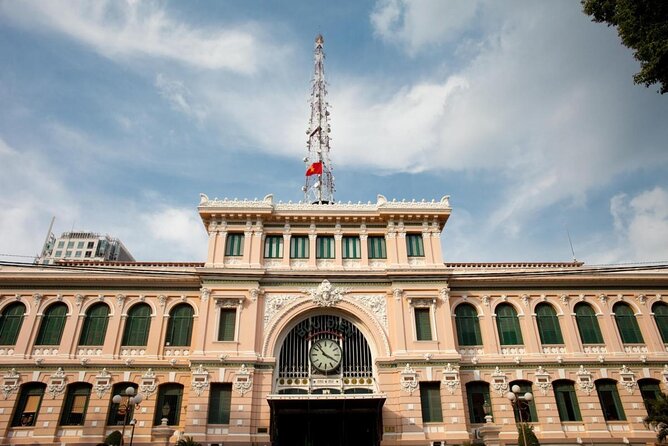
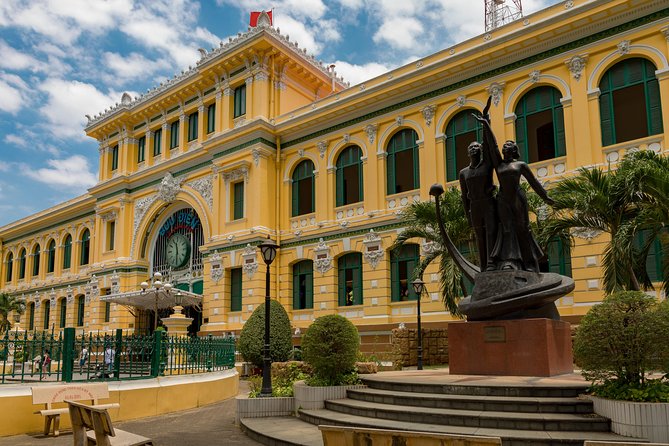
Across the way is the Central Post Office, one of those buildings you can’t help but admire even when you’re rushing. Built between 1886 and 1891 and designed by Marie-Alfred Foulhoux (often credited to Eiffel), it has a classic French concourse look with painted historical maps on the walls.
The most “wow” moments come from details:
- the barrel-vaulted space,
- the tiled floor,
- and the green-painted wrought iron.
At one end you’ll find a mosaic of Ho Chi Minh. This is also a place that still feels usable, which helps it avoid becoming just a museum facade.
Plan for about 30 minutes. If you like buying small keepsakes, this is also a good place to do it before you reach the more intense shopping energy of Ben Thanh.
People’s Committee Building and Nguyen Hue: when the lights matter
You then reach the People’s Committee Building at the end of the Nguyen Hue walking promenade. This is a “look closely” stop, because the main interest is in the crafted details: embossed statues, bas-reliefs, and a Ho Chi Minh statue in front of the main building.
The standout advice here is timing. Evening visits tend to make the features easier to see because the building is illuminated with LED lights. If your day’s schedule allows, this stop is one of the best chances to catch a more dramatic city view without needing a separate night tour.
Expect about 20 minutes, and don’t feel you have to stare at every panel. Just catch the overall look, then pick one or two details to focus on.
Dong Khoi Street and Saigon Opera House: colonial glamour in motion
Next up is the wide story of Ð Dong Khoi. During the French occupation it was called Rue Catinat, and the street’s identity is still visible in the way the city centers people-watchers and architecture.
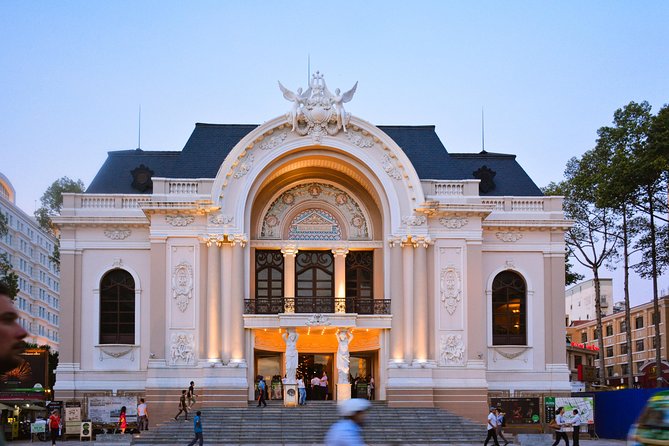
You also visit the Saigon Opera House (Ho Chi Minh Municipal Theater) at the intersection of Ð Dong Khoi and ÐL Le Loi. Built in 1897, it’s one of Ho Chi Minh City’s most recognizable colonial-era buildings, with a grand staircase and belle époque flair.
If you care about performance culture, this is more than a photo stop. The theater’s role has ranged from ballet and opera to modern dance and musicals, so even if there’s no show during your visit, the building reminds you that the city has long had a stage culture.
This part is about 20 minutes with free admission on this itinerary, which is enough to get the exterior character and decide if you want to linger.
Nguyen Hue Street: a pedestrian spine for photos and night energy
Nguyen Hue Street is a broad pedestrian promenade in District 1, lined with French colonial-era buildings. You’ll pass or see the People’s Committee area, the Rex Hotel area, and a luxury shopping mall zone.
In front of the People’s Committee building you’ll also find a statue of Uncle Ho Chi Minh, plus a fountain show at night. If your tour timing lines up with evening, this area can add a different feel to the day—more relaxed, more “city live,” less museum mode.
This segment is built into the schedule around your other stops, so treat it as a flexible transition space. Use it for photos, a short rest, and letting the day breathe.
Ben Thanh Market: your final stretch of bargains and color
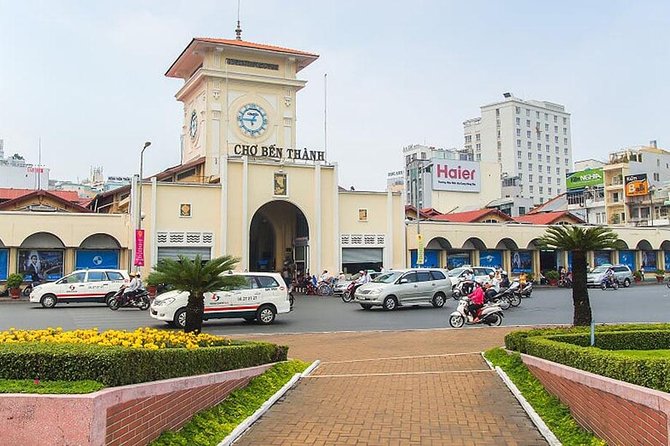
You end at Ben Thanh Market, and honestly, it’s a smart finish. It’s centrally located and one of the liveliest parts of District 1, with stalls packed high with everyday goods, souvenirs, and snacks.
Here’s how to shop without getting frustrated: prices are usually higher than elsewhere, vendors can be pushy, and bargaining is expected. The most important instruction is to ignore any sign that says fixed price, and negotiate in a friendly, matter-of-fact way.
You’ll have about 30 minutes. That’s not “full market exploration” time, so decide quickly what you want:
- small souvenirs and gifts,
- snacks or treats,
- or a final craft purchase.
If you need time to compare prices, this is the part where you’ll either do it fast or keep it simple. Your guide can also help you avoid wasting effort on the most repetitive stalls.
Lunch and bottled water: a real pause in the middle
A major value point here is that lunch is included at a Vietnamese restaurant, along with bottled water. This matters because city days can easily turn into “I’ll eat later” stress, especially when you’re hopping between museums and temples.
The itinerary notes that beverages during the meal aren’t included, so if you drink soft drinks, juices, or alcohol, you’ll want to plan for that.
If you’re choosing between tours, this one earns points because you get that built-in break instead of relying on luck to find a decent meal near the exact sight you’re visiting next.
Price and value: what $100 buys in a private day
At $100 per person, the value looks strong when you look at what’s included. You’re getting:
- private transportation,
- a private tour guide,
- all fees and taxes,
- entrance fees included for the paid stops,
- lunch at a Vietnamese restaurant,
- and bottled water.
The real question isn’t only the cost—it’s whether this is cheaper than piecing it together yourself. With entrance fees handled and transport plus a driver bundled in, it’s often easier to come out ahead, especially if you’d rather not manage tickets, opening hours, or directions across multiple major sites in one day.
What’s not included is also important:
- accommodation and flights,
- personal expenses,
- tips for guide and driver,
- and beverages during the meal.
If you’re the type who hates surprise costs, this itinerary is set up to avoid them.
Guide quality can shape the whole day
A private tour lives or dies on the guide’s style, and the experience here has been described as thoughtful and prepared. In prior bookings, Thai Nguyen has been singled out as informative and caring, and Mr. Tai has been noted as kind and very knowledgeable.
You can’t count on a specific person, but you can do a lot to set things up in advance. If you’re visiting for history, ask your guide to connect the museum and palace stops to what you see on the streets afterward. If you’re more into architecture and temples, tell them so you get enough time to look at the details.
Also, remember that this is a private tour for your group only, so your pace is the plan. If you want more time in a place, ask. If you want fewer photos, say so. That’s the whole point.
Who this tour suits best
This fits best if you want:
- a single-day overview of District 1’s major sights,
- a guide to explain context without crowd pressure,
- and an itinerary that finishes at a fun shopping area.
It also works well if your group includes different interests—museums, temples, and architecture all show up in one route. The downside is tone: the War Remnants Museum stop is emotionally heavy, so plan accordingly.
One more consideration: it’s not wheelchair accessible, and the itinerary notes most travelers can participate, so it’s generally manageable for people who can walk.
Should you book it?
I’d book this private Ho Chi Minh City day tour if you value a guided, efficient route with entrance fees covered and a real lunch break. The combination of Independence Palace, War Remnants Museum, a major pagoda, and the French colonial core around Notre Dame and the Central Post Office makes the day feel like more than a checklist.
But don’t ignore the one reliability warning. Before you head out, confirm your pick-up details and keep your contact info accessible in case the operator needs to reach you.
If that schedule concern keeps you up, you could also plan to meet your guide at the Independence Palace area to reduce stress around hotel pick-up.
If your group includes people who want flexibility, this one delivers: you can spend more or less time in key areas and end with shopping at Ben Thanh Market while the day is still fresh.
FAQ
Is this tour private?
Yes. It’s a private tour/activity, so only your group participates.
How long is the Ho Chi Minh City private tour?
It runs for about 8 hours.
Where does the tour start and end?
It starts at Independence Palace in District 1 and ends at Ben Thanh Market, also in District 1.
Is hotel pick-up included?
Pickup is offered, or you can meet your guide at Independence Palace.
Are entrance fees included?
Yes. The tour notes that all entrance fees are included for the paid stops.
What about lunch?
Lunch is included at a Vietnamese restaurant, plus bottled water. Beverages during the meal are not included.
What does the tour cover?
You’ll see Independence Palace, the War Remnants Museum, Emperor Jade Pagoda, Saigon Notre Dame Cathedral, the Central Post Office, the People’s Committee Building area, Saigon Opera House, and you’ll finish at Ben Thanh Market.
Is it wheelchair accessible?
No. The tour is not wheelchair accessible.
Is there a cancellation option?
Yes. You can cancel for a full refund if you cancel at least 24 hours in advance.
What ticket format do I get?
The tour includes a mobile ticket. Confirmation is received at time of booking.